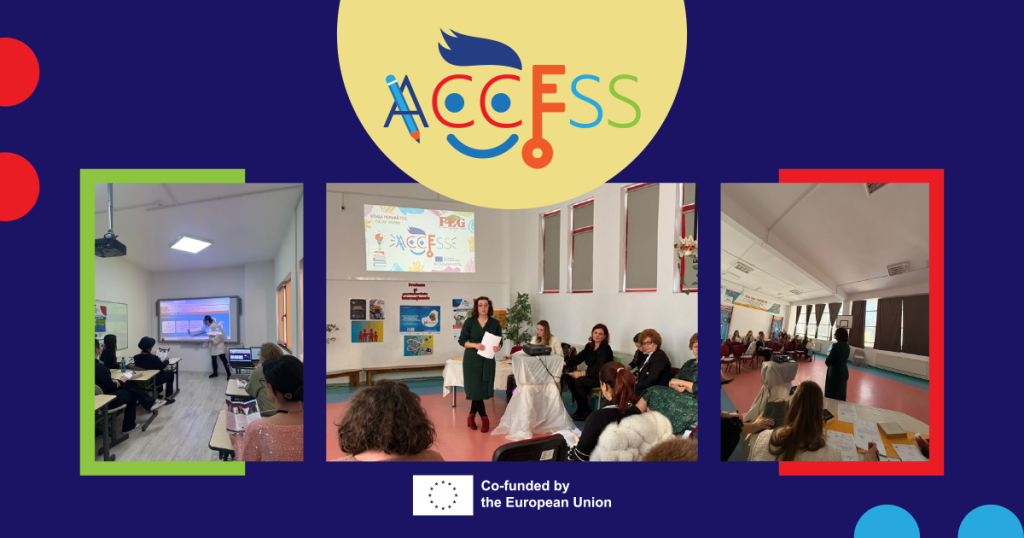
The Collaborative Ecosystem: A Psychological and Pedagogical Blueprint for Inclusive Education in Romania
In the Romanian educational landscape, the transition toward inclusive classrooms is often met with a significant hurdle: the “training-implementation gap.” While the commitment to student welfare is high, many educators find that their formal university training provided a theoretical foundation but lacked the specialized, multidimensional tools required to manage neurodiversity.
The ACCESS Project serves as more than just a resource hub; it is the practical application of the psychological “Systems Theory,” ensuring that every child is surrounded by a synchronized network of support.
1. The Psychological Foundation: Why Collaboration Matters
To understand why the ACCESS Project is essential, we must look at the psychological environment of a child with learning difficulties. According to Urie Bronfenbrenner’s Ecological Systems Theory, a child’s development is influenced by the “microsystems” they inhabit—the school and the home. When these systems don’t communicate, the child experiences “systemic friction,” which manifests as high cortisol levels, anxiety, and academic shutdown.
By fostering relationships between teachers, school therapists, and parents, the ACCESS Project aligns these systems. This alignment is crucial for Self-Determination Theory (Deci & Ryan), which suggests that for a student to succeed, they need to feel competent, autonomous, and related. When the adults in a child’s life collaborate, the child feels “related” to their environment, which is the primary psychological prerequisite for learning.
2. The Teacher-Therapist Alliance: Bridging Clinical and Pedagogical Knowledge
In many Romanian schools, the therapist and the teacher operate in parallel universes. The therapist understands the “why” of a child’s struggle, while the teacher manages the “how” of the classroom.
As noted in Lev Vygotsky’s “Zone of Proximal Development”, learning occurs best when the instruction is tailored to the child’s specific potential. However, a teacher cannot find that zone alone if they haven’t been trained to recognize the nuances of learning disabilities.
The ACCESS Solution: Through the “ACCESS in Learning Difficulties” e-learning modules, the project provides teachers with the clinical literacy needed to partner effectively with therapists. This ensures that the therapist’s recommendations aren’t just “lost in translation” but are actively integrated into the daily lesson plan.
3. Peer-to-Peer Inter-School Collaboration
One of the most innovative theses of the ACCESS project is that “expertise should be shared, not hoarded.” In Romania, the relationship between teachers from different schools creates a broader community of practice.
- Reducing Teacher Burnout: Psychology teaches us that professional isolation is a leading cause of burnout. When teachers collaborate across schools, they share the emotional and cognitive load.
- The Digital Library: This is the project’s “collective brain.” It offers a repository of strategies that allow a teacher in one city to benefit from a successful intervention designed by a colleague across the country, ensuring that the child experiences a consistent, evidence-based approach regardless of their location.
4. The Parent-Teacher Partnership: Creating a Stress-Free Continuum
For a child with special needs, the transition from school to home can be a source of immense stress if the expectations and “languages” used in both places differ. In his book The Whole-Brain Child, Dr. Daniel Siegel emphasizes the importance of “integration”—helping a child connect their experiences.
If a teacher uses a specific focus strategy at school but the parent uses a different approach at home, the child’s brain remains in a state of “disintegration” and stress.
The ACCESS Toolkit for Parents and Teachers: This resource provides a unified framework. It moves the conversation away from “behavioral problems” and toward “collaborative solutions.” When the child sees their parent and teacher as a team, their “survival brain” (the amygdala) calms down, and their “learning brain” (the prefrontal cortex) can finally engage.
5. Filling the Gap: Why ACCESS is the Necessary Catalyst
We cannot expect teachers to be experts in every psychological nuance of neurodiversity without providing the materials. The ACCESS project manages to fill the gap left by traditional training through:
- Evidence-Based Materials: Courses that replace guesswork with proven pedagogical interventions.
- Strategic Resources: A digital library that provides the “what to do” for the “what if” moments in the classroom.
- Holistic Frameworks: Tools that empower the partnership between all stakeholders, ensuring the child is the beneficiary of a unified strategy.
Conclusion: From Isolation to Integration
The ultimate goal of the ACCESS project is to shift the burden from the individual teacher to the educational collective. By using these materials to build stronger relationships with therapists, peers, and parents, we are doing more than just teaching—we are creating a psychological safe haven.
When we bridge the training gap, we don’t just improve grades; we improve lives. We create a future where the classroom is a place of comfort, not a place of stress, for every student.
“Together, we build a future where every child thrives!”
Psychological & Pedagogical References
1. Bronfenbrenner, U. (1979). The Ecology of Human Development: Experiments by Nature and Design. Harvard University Press.
Application: Used for the “Ecological Systems Theory” section, explaining how the child’s stress is reduced when the school (teacher/therapist) and home (parents) systems are in alignment.
2. Deci, E. L., & Ryan, R. M. (2000). Self-Determination Theory and the Facilitation of Intrinsic Motivation, Social Development, and Well-Being. American Psychologist.
Application: Used to support the thesis that a child needs “Relatedness” (feeling supported by a collaborative team) to succeed academically.
3. Siegel, D. J., & Bryson, T. P. (2011). The Whole-Brain Child: 12 Revolutionary Strategies to Nurture Your Child’s Developing Mind. Delacorte Press.
Application: Used to explain how a unified strategy between adults helps “integrate” a child’s brain, moving them from a state of stress (amygdala trigger) to a state of learning.
4. Vygotsky, L. S. (1978). Mind in Society: The Development of Higher Psychological Processes. Harvard University Press.
Application: Applied to the “Zone of Proximal Development,” highlighting that teachers need the specific training provided by ACCESS to identify exactly where a child needs support.
5. Wenger-Trayner, E., & Wenger-Trayner, B. (2015). Learning in a Landscape of Practice. Routledge.
Application: Supports the “Community of Practice” thesis—the idea that teachers from different schools must collaborate to share expertise and reduce professional isolation